
Short answer: the Agent Forge Way is fourteen rules for building AI that does real work inside a company, safely. They come down to four ideas: measure before you build, sort every step before reaching for AI, make the agent earn trust before it acts, and keep the owner in control the whole time.
Anyone can buy the same AI models, so the models are not what makes a project work. What makes it work is the way it is built: what gets measured, what the AI is allowed to decide, what has to pass before anything goes live, and what you can undo yourself. We wrote that down as the Agent Forge Way. This post is the short version, for an owner who is new to AI and wants the idea without the detail.
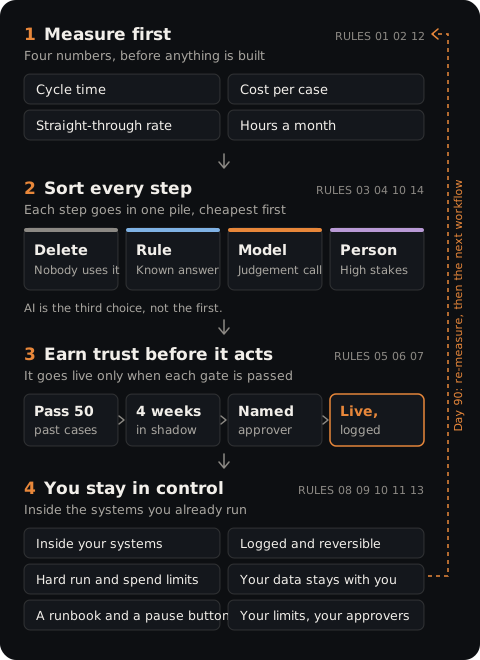
The whole Way on one page: four ideas in order, the rules behind each, and the day-90 loop back to the start. Tap to open it full size.
Why does a company need rules for AI at all?
Because the tool is the easy part. Many companies that have bought AI can't point to one piece of work that got cheaper because of it. Usually, nobody picked a specific workflow, measured it, changed it and measured it again. The rules make sure every build does all four, and they let you hold us to it: every claim on our site points back to one of them.
Idea 1: Measure before you build
Before anything changes, we measure the work as it runs today with four numbers: how long a case takes from start to finish, what one case costs in people's time, how many cases go through without anyone fixing them, and how many hours a month the work eats. Those numbers go into the contract, and the same four are measured the same way at day 90 (rules 01 and 12).
We also build one workflow at a time (rule 02). An owner who wants three things fixed at once gets the one that costs the most first. The second is written down and waits. That first build also lays the plumbing the next ones reuse, which is why the second costs less and moves faster.
Idea 2: Sort every step, and use AI only where it's needed
Every step in the process goes into one of four piles, in this order (rule 03):
- Delete it. If nobody uses what the step produces, stop doing it.
- Write a rule for it. If the answer is already known or follows a fixed rule, ordinary software does it, the same way every time.
- Give it to a model. If it means reading messy input or making a judgement call, that is where AI earns its place.
- Keep it with a person. If it is high-stakes, a relationship or someone's accountability, it stays with a person.
AI is the third choice, not the first. Even where it is used, it reads and classifies; rules check the numbers, and a model never decides on its own whether a number is acceptable (rule 04). Each step that does need a model gets the cheapest one that passes the tests (rule 10).
Sometimes the sort shows that the work is slow because of a policy, like an approval nobody needs, and not for lack of software. Then the answer is to change the policy and build nothing. "Not worth automating" is a complete answer (rule 14).
Idea 3: The agent earns trust before it acts
Nothing goes live on a promise. Three things have to happen first:
- It passes a test drawn from your own history. At least fifty past cases from your business, chosen with the person who does the work today so they include the awkward and high-stakes ones. The agent goes live only when it passes all of them, and the test runs again every time anything changes (rule 05).
- It shadows your person before it acts. For four weeks it runs beside the person who does the work and posts nothing; every difference is reviewed. Then it handles the clear cases and sends the rest to a person. Only then does it run. You decide when it moves from one stage to the next (rule 06).
- A named person owns every exception. Anything outside your limits goes to someone you name, in the email or chat they already use, with the reason. Your approval limits stay yours (rule 07).
Idea 4: You stay in control
- It works inside the systems you already have. Your ERP, CRM and inbox. Approvals land where they already land, and nobody learns a new tool or logs into anything of ours (rule 09).
- Everything is logged and reversible. What it read, what it decided, what it posted and when. A wrong entry can be found and reversed in one place, by your people, without us (rule 08).
- It has hard limits. Every agent has a ceiling on how much it can run and spend that it cannot exceed (rule 10).
- Your data stays with you. It runs through your own cloud account, in a Canadian region where one exists, under terms where the provider keeps nothing, and nothing trains anyone's model (rule 11).
- You can run it without us. Every build ends with a plain-language runbook. The business rules and limits sit outside the code, so your process owner can change one without an engineer, and one screen shows what is running, pauses it and rolls back a wrong entry. Keeping us on afterwards is your choice (rule 13).
Where do I start?
With one piece of work that repeats in your business and costs you more than it should: supplier invoices, quotes, order entry, scheduling, collections. Write down how it actually runs, step by step, and try sorting each step into the four piles above. That alone usually shows where the time goes.
The full version, with every rule, what enforces it and how a sprint runs, is the Agent Forge Way.